East Point Engineering Students develop IoT-based Smart Women Safety Device with Real-Time Emergency Alerts

In a significant step toward leveraging technology for social impact, students from the Department of Computer Science & Engineering at East Point College of Engineering & Technology (EPCET), Bengaluru, have developed an innovative “Smart Women Security System Using IoT” – a compact wearable safety device designed to provide real-time emergency assistance and improve women’s personal safety.
Developed by students Abhinav Mallappa Radder, Abhishek Gowda MS, Madhan M S, and Rekha S under the guidance of Dr. Kesavan M V, the project integrates multiple technologies including GSM, GPS, IoT sensors, cloud connectivity, and health monitoring systems into a single intelligent safety platform.
The wearable prototype is designed to detect emergency situations such as sudden falls, abnormal movement, unsafe surroundings, or distress scenarios, and instantly send SMS alerts with live GPS location to family members or emergency contacts. Unlike many existing safety applications that rely heavily on smartphones and internet connectivity, the system is capable of functioning through GSM-based communication, ensuring better reliability during emergencies.
The project incorporates several advanced safety features including real-time GPS tracking and GSM- based emergency alerts that instantly share the user’s live location during distress situations. The device is also equipped with accelerometer sensors capable of detecting sudden falls and unusual movements, while an integrated MQ-3 sensor helps identify the presence of alcohol in nearby surroundings. In addition, the system monitors vital health parameters such as heart rate and body temperature and uploads the data to the Blynk cloud platform for remote access. To further enhance safety, the prototype includes a camera activation feature for evidence collection during emergencies along with a low- voltage self-defense deterrent mechanism designed for immediate response situations.
The prototype was successfully tested under controlled conditions and demonstrated reliable GSM connectivity, GPS accuracy, emergency alert transmission, and effective sensor-based monitoring. The students noted that while the device has shown promising results at the prototype stage, additional real- world testing and regulatory compliance would be required before commercial deployment.
Speaking about the project, Dr. Manimozhi I, Head of the Department, CSE, EPCET, said: “This project reflects our institution’s commitment to fostering innovation in socially relevant domains.
Women’s safety is a critical issue, and the integration of technology-driven solutions like this device demonstrates the potential of student-led research to make a real-world impact.”
Commenting on the project, Dr. Kesavan M V, Associate Professor, CSE, EPCET and Project Guide, said: “The team has successfully combined multiple technologies including GPS, GSM, alcohol detection, and health monitoring into a compact prototype aimed at enhancing women’s safety. The results achieved so far are promising and showcase the students’ technical capabilities and dedication toward solving real-world challenges.”
The project also highlights how affordable embedded systems and IoT-enabled solutions can play an important role in building safer public environments for women. With future enhancements such as AI-based threat detection, mobile app integration, and direct emergency service connectivity, the system has the potential to evolve into a scalable smart safety solution.
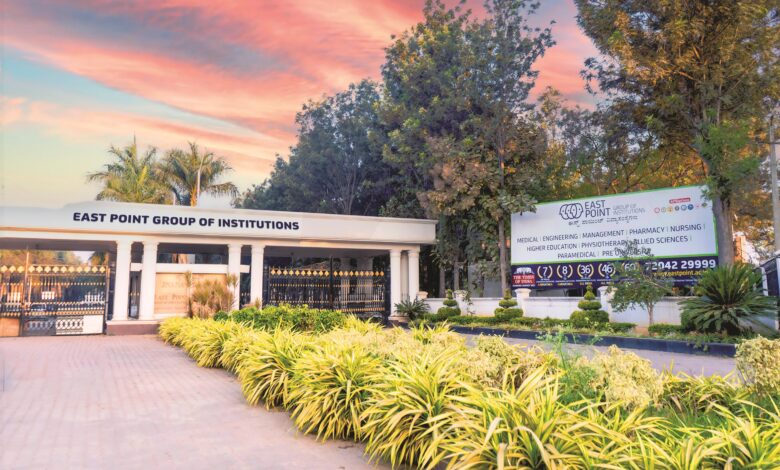
About East Point Group of Institutions
Established in 1997 under the visionary leadership of Dr. S.M. Venkatpathi and under the auspices of M.G. Charitable Trust, East Point Group of Institutions, based in Bengaluru, has emerged as a beacon of excellence in education. It is a multidisciplinary academic ecosystem with over 10,000 students pursuing programs in Medicine, Engineering, Management, Commerce, Computer Applications, Pharmacy, Nursing, Physiotherapy, Allied Health Sciences, and other disciplines.
Spread across a sprawling 100+ acre lush green campus, the institution is supported by a state-of- the-art 1200-bedded Multi-Speciality Hospital. The institution focuses on an industry-integrated curriculum, structured skill development, global certifications, a strong coding culture, faculty empowerment, and long-term corporate engagement to develop industry-ready professionals.