KSLSA & Dhare Foundation – 5 Crore Tree Afforestation and Ecological Restoration Mission

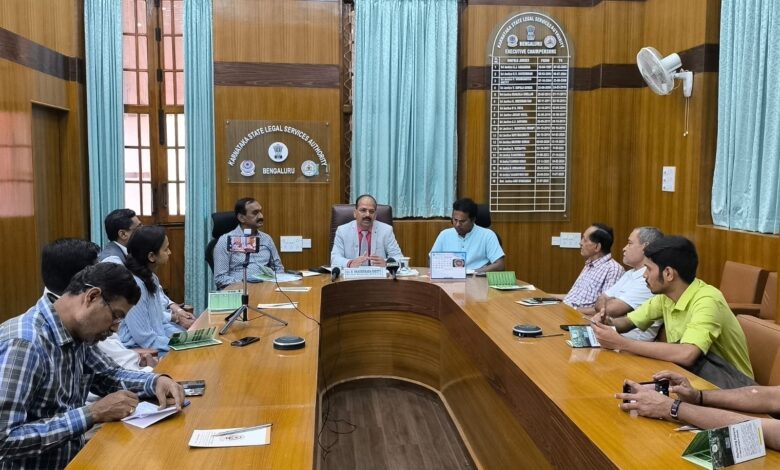
Karnataka State Legal Services Authority (KSLSA) in collaboration with the Dhare Foundation, is launching a large-scale environmental initiative to plant 5 Crore saplings across Karnataka, with 2 Crore saplings in and around
Bengaluru under the “Green Ring Bengaluru” mission and the remaining 3 Crore across other districts of the State.
This initiative is designed not as a conventional plantation drive, but as a long- term ecological restoration program focused on biodiversity, climate resilience, and water sustainability.
1) Implementation Strategy – Geography, Scale and Execution
The project will be implemented in a structured and scientific manner across Karnataka:
Bengaluru – Green Ring (2 Crore Saplings):
Plantation will be carried out within a 50 km radius of Vidhana Soudha, divided into three zones:
Urban Core (0–10 km): 20 lakh saplings
Peri-Urban Zone (10–30 km): 80 lakh saplings
Rural/Forest Belt (30–50 km): 1 crore saplings
Rest of Karnataka (3 Crore Saplings): Plantation will be undertaken across districts through:
Government lands and institutional campuses
Lake buffer zones
Degraded lands and agro-forestry models
Road corridors and public spaces
Execution Framework:
Scientific plantation methods (Miyawaki, agro-forestry, avenue plantation based on geography)
Soil preparation, planting, mulching, and watering protocols
Continuous monitoring through GPS tagging and geo-mapping
Monthly tracking of survival and growth
Community participation and institutional collaboration KSLSA will play a critical facilitative role by coordinating with District Legal Services Authorities (DLSAs) to:
Secure permissions from local authorities
Enable coordination with Panchayats, District Administration, and Government Departments
Support ground-level implementation across districts
2) Why Miyawaki Method in Green Ring Bengaluru
The Green Ring Bengaluru mission adopts the Miyawaki method to address the ecological crisis caused by rapid urbanisation.
a) Creating Biodiversity Hubs With increasing construction activity in and around Bengaluru, natural
habitats for birds, butterflies, bees, and insects are disappearing. Miyawaki forests:
Create dense, multi-layered vegetation
Provide food, shelter, and nesting spaces
Act as mini-forests that become natural homes for living species Protecting biodiversity is essential to maintain the cycle of life—pollination, soil regeneration, and ecological balance depend on the presence of diverse species.
b) Natural Bio-Walls Against Pollution Miyawaki forests function as green bio-walls:
Dense foliage traps dust, PM2.5, and PM10 particles
Reduces spread of air pollution
Improves urban air quality
c) Higher Carbon Absorption compared to conventional vegetation, Miyawaki plantations:
Grow faster and denser
Absorb significantly more CO2
Contribute to climate change mitigation
d) Reduction of Urban Heat (Cooling Effect)
Dense canopy cover provides continuous shade and reduces direct solar radiation
Evapotranspiration from thick vegetation cools the surrounding air
Helps reduce the urban heat island effect, leading to a noticeable drop in
local temperatures
Contributes to making surrounding areas more livable, especially in highly concretized zones
e) Groundwater Recharge
Dense root systems slow down rainwater runoff
Improve soil infiltration
Enhance groundwater recharge
3) Moving Beyond Monoculture – Native Ecological Planting
This 5 Crore plantation initiative is fundamentally different from traditional plantation models.
It avoids monoculture plantations such as areca, coconut, and acacia,
which:
o Do not support biodiversity
o Fail to attract pollinators
o Do not create ecological balance
Instead, the project focuses on:
o 100% indigenous species
o Around 90% fruiting and flowering trees
o Supporting birds, bees, butterflies, and other species
In large monoculture plantations like acacia, it is often observed that even honeybee nests are absent, highlighting the lack of ecological value. This initiative aims to reverse that trend by creating living ecosystems, not just tree cover.
4) Lake Rejuvenation – Integrated Water Sustainability
Karnataka has more than 45,000 tanks (lakes), many of which are degraded. As part of this initiative:
Dhare Foundation will undertake efforts towards:
o Cleaning and desilting lakes
o Restoring feeder channels
o Strengthening lake ecosystems
o Plantation around lake peripheries
This will help:
Improve groundwater recharge
Restore aquatic biodiversity
Support agriculture and farmers
Reduce flood risks and improve water availability
5) Resource Mobilisation and Public Participation
This mission is designed as a collaborative effort involving institutions, corporates, and citizens.
CSR partners, institutions, and individual donors are invited to contribute
Donor names will be displayed at plantation sites
GPS coordinates of plantation locations will be made publicly available through the website for transparency and monitoring
Community participation will be encouraged to ensure long-term sustainability
Conclusion
The 5 Crore plantation initiative by KSLSA and Dhare Foundation is a transformative step towards restoring Karnataka’s ecological balance. By combining scientific plantation methods, biodiversity restoration, pollution
control, temperature reduction, and groundwater recharge, this mission goes beyond planting trees—it aims to rebuild self-sustaining ecosystems for future generations.
Along with afforestation, the integrated focus on lake rejuvenation across more than 45,000 tanks will revive Karnataka’s traditional water systems, strengthen groundwater reserves, and restore aquatic biodiversity. Together, tree plantation and water body restoration form a unified ecological strategy to ensure long-term environmental sustainability for the State.