
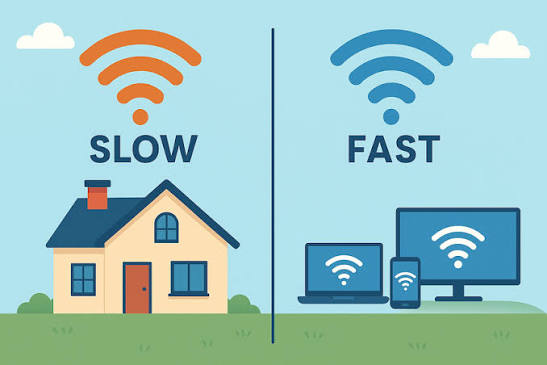
There is a familiar moment in many homes- the workday ends, people return and devices reconnect to Wi-Fi. Nothing has changed about the broadband plan. Yet the internet suddenly feels slower. It is tempting to blame the internet connection itself. But the more interesting explanation lies inside the home.
The modern home is no longer connecting 1-2 devices to the internet. It is operating a small digital ecosystem, with multiple people and machines asking for connectivity at the same time. Assurant’s 2025 Connected Decade study found that Indian households own an average of 12.9 connected devices, the highest among the nine markets surveyed. That changes the nature of the problem. The question is no longer simply, “How fast is my broadband?” It is increasingly, “How well does my home network manage competition?”
The evening rush is a network problem in miniature
Think of a home broadband connection as a road leading into a neighbourhood. The broadband plan determines, broadly, how much traffic can enter that road. But once the traffic reaches the house, it still has to move through a much smaller network of wireless links, rooms and devices. At 7 PM, those links can suddenly become crowded. A television may be pulling a continuous high- resolution video stream. A phone may be backing up photos. A laptop could be downloading a large file or synchronising cloud storage. Smart speakers, cameras and appliances may be quietly exchanging data in the background. But not every activity behaves in the same way.
A video stream can usually handle a little variation because content is buffered in advance. A game cannot. A few hundred milliseconds of additional delay can matter far more to a player than a temporary reduction in download speed. A video meeting has a similar sensitivity- what matters is not just how much data is moving, but whether packets arrive consistently. This is why a household can have a high-speed broadband connection and still experience a frustrating evening online.
Bandwidth is only one part of the equation
Internet performance inside a home is shaped by several layers. There is a broadband connection coming into the premises. Then there is the router distributing that connection. Then there is the wireless environment, where walls, distance, interference and the number of simultaneously active devices influence performance.
The wireless link between a router and devices can itself become a bottleneck, even as broadband connection speeds rise. Its guidance also notes that the more devices using Wi-Fi, the more the available capacity is shared between them. That distinction matters because consumers often measure the wrong
thing.
A speed test conducted next to the router may show an excellent result. Move the same laptop two rooms away, close a few doors, add several active devices and start a video stream, and the experience can be very different. In this case, the broadband connection has not necessarily deteriorated. The conditions under which that connection is being delivered have changed.
Design the network around behaviour
This is where a good home Wi-Fi setup becomes important. The objective should be to manage different kinds of traffic predictably. Dual-band connectivity can allow devices to use different frequency bands according to their needs, while a capable router can manage multiple simultaneous connections more effectively. Intelligent device management and traffic prioritisation can help maintain a more consistent experience when several devices are active. For larger homes, mesh Wi-Fi can solve a different problem- distance. Instead of asking one router to
push a usable signal through every wall and room, a mesh system uses interconnected access points to extend coverage. This can reduce weak-signal areas and improve consistency when a setup sits far from the main router. The goal is not to create a faster connection in theory. It is to create a more reliable one in the places where people actually use it.
Conclusion
India had more than 1.06 billion broadband subscribers by March 2026, according to TRAI, while total internet subscribers stood at about 1.09 billion. These numbers reflect how deeply connectivity has moved into everyday life. The next challenge is therefore less about getting people connected and more about ensuring that connectivity performs reliably when demand peaks.
The evening slowdown is a useful reminder of that distinction. The future of home connectivity will not be defined only by faster plans. It will be shaped by how intelligently networks manage competing demands, how effectively they distribute coverage and how consistently they deliver the right experience to the right device.
Because when everyone gets home, the internet is not suddenly weaker. There are simply many more people asking it to do many more things at once.
( Ravi Karthik , Chief Growth Officer, ACT Fibernet )


