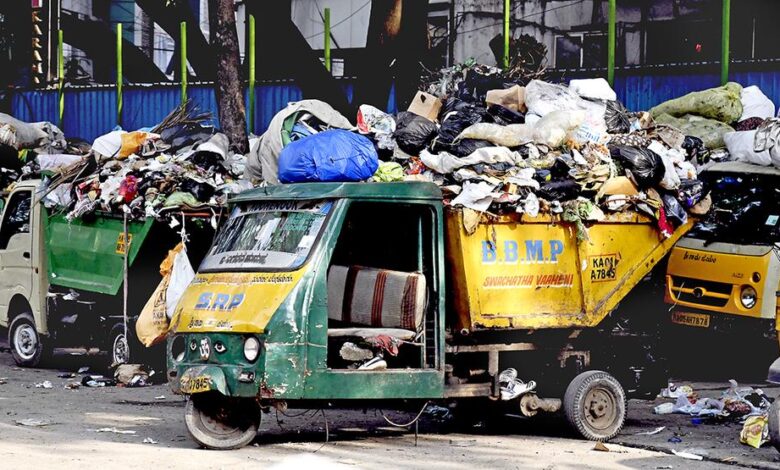
Bangalore had earned the “Garden City’ title due to its lush parks, pleasant climate, and abundant trees planted over centuries, but it has transformed into “Garbage city” stems from a massive surge in waste generation (1750% increase in 15 years) outpacing infrastructure, leading to unsegregated garbage piling in “black spots” inefficient collection, and inadequate processing, causing public health issues, environmental blight, and traffic disruption, despite solutions like mandatory segregation and decentralized management being available but poorly implemented. In Bengaluru, the Bruhat Bengaluru Mahanagara Palike (BBMP) oversees waste management, with its Bengaluru Solid Waste Management Limited (BSWML) subsidiary specifically handling door-to- door collection via contractors, ensuring segregated waste (wet/dry) is picked up by Pourakarmikas (sanitation workers) using pushcarts/autos, though implementation varies by area, with BBMP also managing street cleaning and public health aspects of sanitation. BBMP collects around 5,000 to 6,000 tonnes of waste daily in Bengaluru, with a significant portion collected door-to-door. However, the exact daily door-to-door
tonnage is included in the total, and it often shows high levels of unsegregated waste despite efforts to promote segregation at source. While total generation is high (around 6,000 TPD), only a portion (e.g., 2,000 tonnes) is segregated, with the rest being mixed waste collected via various methods, including door-to-door collection.
Pourakarmikas, the backbone of Bengaluru’s waste management face significant challenges despite their crucial role in maintaining public health and cleanliness, as they work in unhygienic conditions exposed to hazardous waste without proper protective equipment, leading to various health issues, and struggle with low and erratic wages, lack of basic facilities like washrooms and drinking water, social stigma, and limited job security, highlighting the need for better working conditions, wages, and social recognition.
BBMP elections in Bengaluru have faced persistent delays, with the last one held in 2010, leading to long periods of Administrator rule, often due to government tactics like delaying delimitation (redrawing wards) and reservation processes, frustrating citizens seeking accountable local governance. While specific dates for the next election aren’t set as of early 2026, the pattern shows frequent political unwillingness to conduct polls,
highlighting a systemic issue with fulfilling local democratic processes in the city. The absence of elected officials means there is less scrutiny and oversight at the regional level. Issues such as encroachment on public land and illegal construction have reportedly increased during this period. Without corporators monitoring civic works, the
checks and balances inherent in a democratic local body are missing, allowing irregularities to persist with fewer consequences.
The Karnataka government recently introduced a unique reward scheme, under Bengaluru Solid Waste Management Ltd (BSWML) and GBA, in which citizens who share photos or videos of people dumping garbage on public roads or empty sites via a designated WhatsApp group can receive a reward of Rs 250. This initiative was made to address persistent public littering issues in Bengaluru and foster a sense of shared civic responsibility. But in reality, it is hard to catch someone throwing garbage. People usually throw waste quickly and leave, and by the time we notice it, the person is already gone, so we can only look at the garbage that has been thrown, meaning that the act or the person will remain unidentified. Because of these challenges, the reward system may not produce drastic or lasting change unless basic issues such as regular waste collection and
effective communication are addressed first.
The uncollected garbage, especially that thrown by residents on roadsides, has become a severe, chronic crisis in Bengaluru, with piles of mixed waste, including plastic and food, strewn across streets, parks, and beneath metro pillars. This situation has led to significant animal welfare issues, with cows and dogs consuming dangerous materials, and poses significant public health risks, including a surge in dog bites and potential outbreaks of infectious diseases. Stray cattle, often let out by owners to forage, consume large amounts of plastic waste found in garbage piles, particularly near markets like Kalasipalayam and Madivala. Animals fed on trash often develop bloated stomachs, leading to reduced food intake and lower milk production. The milk consumed by residents is contaminated with bacteria and toxins from the garbage. Stray dogs and cats are frequently seen rummaging through open waste and sometimes get their heads stuck in plastic containers discarded there, causing panic and physical injury.
Swachh Bharat Abhiyan (SBA) is directly related to the Bruhat Bengaluru Mahanagara Palike (BBMP), as the city body implements the mission’s urban goals for waste management, but it has faced significant criticism for failing to meet standards, leading to low national rankings (like 36th in 2024-2025), issues with public toilets, poor infrastructure, and inadequate waste processing, despite central awards and budget allocations, showing a gap between paper goals and ground reality. Countries like Germany and Switzerland have high standards of cleanliness, with strict, legally binding regulations governing household waste management and sorting.
Households and public spaces have strict rules and regulations; improper sorting of household trash, particularly in apartment complexes, can lead to fines. Norway continues to be a global role model for healthy, sustainable living, as it uses a highly structured, source-segregated household garbage collection method that emphasises
sustainability, with 91% of households actively sorting their waste. The primary mode of collection is “Kerbside Pickup”, featuring a multi-bin system where waste is separated into different containers at the household level, often with four bins and separate bags for plastic, food, paper, glass, and metal, and the trucks collect these separated fractions directly from homes at regular intervals. A global example to look at is Singapore, recognised as ‘Mr. Clean of the world because they combined strict laws, effective waste management systems, recycling programs and extensive urban planning. Moreover, when it comes to waste collection vehicles, they use digital tech (smart bins, apps) that run on fixed schedules, which households can easily check, and changes are well-notified.
Instead of implementing schemes like rewarding Rs. 250 for the person who spots someone throwing garbage on the road, the government can adopt policies and strict rules and regulations from countries such as Germany, Switzerland, Norway, and Singapore.
( Thejaswini N,is a Research assistant, Department of International Relations, Peace and
Public Policy (IRP and PP), St Joseph’s University, Bengaluru & Dr. Areesh is Head, Department of International Relations, Peace and Public Policy (IRP and PP), St Joseph’s University, Bengaluru)